


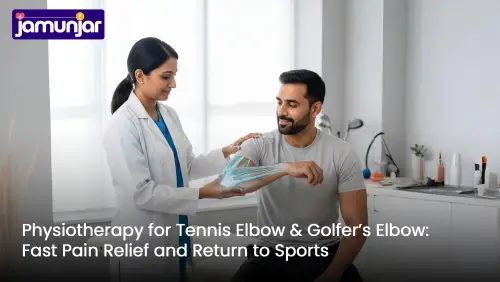
Physiotherapy for Tennis Elbow & Golfer’s Elbow – Fast Pain Relief and Return to Sports
Blog Summary
This article explains how tennis elbow and golfer’s elbow can develop due to repetitive strain injuries, why physiotherapy for tennis elbow and physiotherapy for golfer’s elbow are widely recommended in treatment plans, and how evidence-based musculoskeletal (MSK) physiotherapy can help reduce pain, support tendon healing, and enable a safe return to sport.
It also compares bracing, taping, and exercise therapy, highlights important red-flag symptoms, and explains how professional care can be accessed at a physiotherapy center in Mumbai or through physiotherapy at home in Mumbai , depending on your needs and convenience.
Introduction
Elbow pain is common in athletes, office workers, manual workers, and people whose jobs or routines involve repeated use of the arms, wrists, or hands. Two of the most common causes are tennis elbow, known as lateral epicondylitis, and golfer’s elbow, known as medial epicondylitis. Despite their names, these conditions do not affect only sportspeople. They often develop because of repetitive overuse in everyday activities.
Clinical guidance consistently emphasizes that physiotherapy for tennis elbow and physiotherapy for golfer’s elbow play a central role in reducing pain, restoring strength, and preventing recurrence. Structured exercise and load management are widely considered first-line approaches for tendon-related elbow problems.
Whether you visit a physiotherapy center in Mumbai or choose home-based physiotherapy, understanding the rehabilitation process can help you set realistic recovery goals and stay consistent with treatment.
Why Repetitive Strain Causes Elbow Tendon Injuries
Tennis elbow and golfer’s elbow are classified as tendinopathies. This means they usually involve degeneration and overload of tendon tissue rather than only short-term inflammation.
Grip Overload, Technique Faults, Forearm Imbalance
Grip overload: Repeated gripping, lifting, typing, or repetitive use of tools can place too much stress on the forearm muscles attached near the elbow. Over time, this can exceed the tendon’s natural healing capacity and lead to pain, weakness, and functional limitation.
Technique faults: Sports such as tennis, badminton, cricket, and golf require proper swing technique and suitable equipment to reduce tendon strain. Similarly, poor workplace posture and repeated awkward wrist or elbow positions may contribute to ongoing micro-injuries.
Forearm muscle imbalance: Weakness or reduced endurance in the forearm muscles can change how force is distributed across the elbow joint. This may contribute to chronic elbow pain and reduced grip strength.
MSK Physiotherapy Protocol for Elbow Tendon Healing
Evidence-based MSK physiotherapy focuses on progressive loading rather than prolonged rest alone. Properly guided movement helps promote tendon recovery and restores upper limb function more effectively than passive measures alone.
Isometrics, Eccentric Loading, Manual Therapy
Isometric exercises: Early rehabilitation often begins with isometric contractions. These can help reduce pain while avoiding excessive tendon strain, making them a useful and practical starting point.
Eccentric loading: Slow, controlled eccentric exercises are central to tendon rehabilitation. They improve the tendon’s capacity to tolerate load and are commonly included in structured physiotherapy plans. These exercises should ideally be performed under proper guidance, whether through a clinic or through physiotherapy at home in Hyderabad or another preferred city.
Manual therapy: Soft-tissue techniques and joint mobilization may improve elbow and wrist mobility, reduce muscle tension, and support tolerance to exercise. Manual therapy works best as a supportive intervention alongside an active rehabilitation programme.
Good physiotherapy also looks beyond the elbow itself. A comprehensive plan may include assessment of posture, shoulder stability, wrist mechanics, and overall movement patterns. For those with time constraints or limited access, care may also be coordinated through a physiotherapy at home app or a home physiotherapy booking app India .
Sports-Specific Strengthening and Return-to-Play Timelines
A safe return to sports depends on gradual progression, not simply on reducing pain. Recovery should be guided by improved strength, grip function, endurance, and control.
Racquet Sports, Functional Grip Training
Racquet and throwing sports: Athletes usually progress from controlled strengthening to sport-specific drills such as light swings, shadow practice, and eventually resisted movements and return-to-play activity.
Functional grip training: Grip endurance and coordination are essential to reduce the risk of recurrence. Progressive grip loading is generally more effective than complete avoidance of gripping tasks.
Timelines:
- Mild cases: improvement within 6–8 weeks
- Moderate cases: 8–12 weeks with structured physiotherapy
- Chronic cases: longer-term management focused on load tolerance and functional recovery
Return to sport should ideally be based on improved function and strength, not pain reduction alone.
Bracing vs Taping vs Exercise — Evidence-Based Comparison
Passive supports are often used in elbow tendon pain, but their benefits are generally specific, limited, and supportive. They should not replace a structured rehabilitation plan.
When Each Method Helps and When It Doesn’t
Bracing: Counterforce braces may reduce tendon load during some activities and may help in the short term. However, they should not be treated as a replacement for proper rehabilitation.
Taping: Taping may improve proprioception and reduce discomfort during daily activities. Its effects are generally short-term and adjunctive.
Exercise (gold standard): Exercise therapy remains the most effective long-term approach for elbow tendinopathies. Progressive strengthening, movement correction, and load management form the basis of sustainable recovery.
Relying only on braces or taping without proper physiotherapy for tennis elbow or physiotherapy for golfer’s elbow may increase the risk of persistent pain, recurrence, and delayed recovery.
Red-Flag Symptoms Requiring Urgent Medical Evaluation
Although most elbow pain is mechanical, urgent medical assessment is necessary if you experience:
- Sudden severe pain after trauma or a fall
- Progressive weakness or loss of hand function
- Numbness or tingling extending into the hand
- Swelling, redness, or signs of infection
- Pain associated with unexplained weight loss or fever
Immediate medical evaluation is important when neurological symptoms or systemic warning signs are present.
CTA: Book a Musculoskeletal Physiotherapy Assessment to Reduce Pain and Restore Mobility Faster
Early and structured physiotherapy works best for tennis elbow and golfer’s elbow. A qualified physiotherapist can assess movement patterns, prescribe safe loading exercises, and guide your return to work, sport, and daily activities.
Whether you prefer a physiotherapy center in Mumbai or the convenience of physiotherapy at home in Delhi , physiotherapy at home in Mumbai , or physiotherapy at home in Hyderabad , expert care can also be accessed through a physiotherapy at home app or a home physiotherapy booking app India . Professional rehabilitation helps ensure that recovery is safe, effective, and sustainable.
Do not let persistent elbow pain limit your performance. Seek evidence-based physiotherapy care and begin your recovery with a structured plan.
Medical Disclaimer
This article is for educational purposes only. It does not replace professional medical advice, diagnosis, or treatment. Always consult a qualified doctor or physiotherapist before starting, stopping, or changing any treatment for pain or medical conditions. Exercises should only be started after assessment and guidance from a qualified physiotherapist.
References
-
National Center for Biotechnology Information (NCBI). Neck Pain
[Internet]. In: StatPearls. Treasure Island (FL): StatPearls Publishing;
[Accessed Jan 2026].
Available from: https://www.ncbi.nlm.nih.gov/books/NBK557869/ -
National Health Service (NHS). Tennis elbow [Internet]. NHS; [Accessed Jan
2026].
Available from: https://www.nhs.uk/conditions/tennis-elbow/ -
National Health Service (NHS). Repetitive strain injury (RSI) [Internet].
NHS; [Accessed Jan 2026].
Available from: https://www.nhs.uk/conditions/repetitive-strain-injury-rsi/ -
National Health Service (NHS). Physiotherapy: tests and treatments
[Internet]. NHS; [Accessed Jan 2026].
Available from: https://www.nhs.uk/tests-and-treatments/physiotherapy/ -
Manipal Hospitals. Physiotherapy for Tennis Elbow.
Available from: https://www.manipalhospitals.com/blog/physiotherapy-for-tennis-elbow/ -
Fortis Healthcare. Physiotherapy & Rehabilitation.
Available from: https://www.fortishealthcare.com/india/physiotherapy-rehabilitation -
Apollo Hospitals. Physiotherapy Procedure.
Available from: https://www.apollohospitals.com/procedures/physiotherapy/