

Protein Management in a GLP-1 Weight Loss Program
On a GLP-1 program, protein is the first casualty of reduced appetite — and the consequences go beyond weight. This guide covers protein management in GLP-1 weight loss: targets, the best Indian food sources, early signs of muscle loss, and how individualised strength training helps protect muscle.
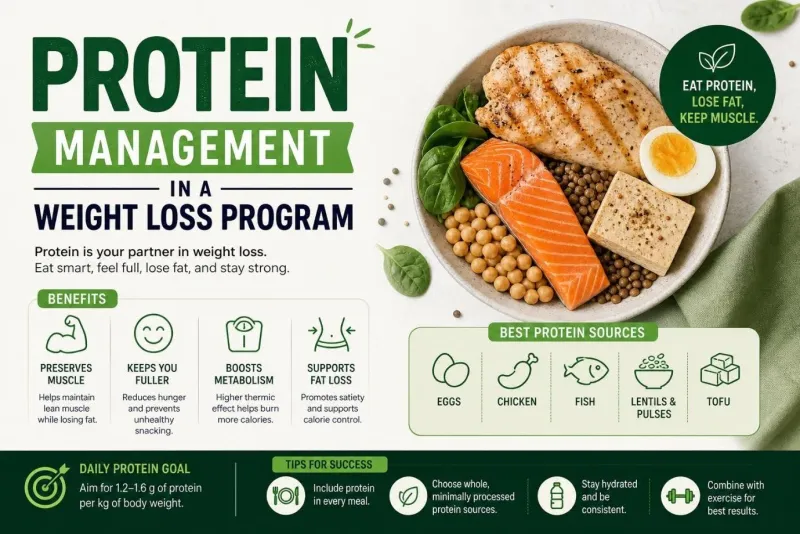
GLP-1 medications are remarkably effective at suppressing appetite — sometimes too effective. When hunger disappears, eating becomes effortful, and the first thing to fall short is protein. On a GLP-1 weight loss program, that is a problem with serious long-term consequences that most patients do not see coming.
Clinical trial data show why protein management in a GLP-1 weight loss program matters. In the DEXA body-composition sub-study of the STEP 1 trial, people taking semaglutide for 68 weeks lost weight that was, on average, about 40% lean mass and 60% fat mass.1 In the equivalent SURMOUNT-1 sub-study of tirzepatide, lean mass accounted for roughly 25% of weight lost — similar to the proportion seen with placebo and with non-medicated weight loss generally.2 The exact share varies by drug, dose, and individual, but the pattern is consistent: GLP-1 medication does not automatically protect muscle, and inadequate protein or inactivity can push that share higher. This guide covers protein targets, the best Indian food sources, early warning signs of muscle loss, and how individualised strength training fits alongside medication. If you are also exploring the broader nutritional picture, our guide on what to eat on a GLP-1 Indian diet covers the full framework.
Key Takeaways
- In clinical trial sub-studies, lean muscle has accounted for roughly 25–40% of total weight lost on GLP-1 medication, depending on the drug and how well protein intake and activity are managed.12
- A commonly used starting point is around 20–30 grams of protein per meal (roughly 0.4g per kg body weight), spread across meals — actual needs vary with body weight, age, and kidney function.3
- Muscle loss is not always visible — fatigue, breathlessness climbing stairs, and poor balance are early warning signs.
- Regular resistance training, matched to your fitness level and supervised where needed, is strongly recommended during GLP-1 treatment to help protect muscle — the right frequency and intensity should be individualised, not identical for everyone.
- Dietary protein independently stimulates your body's own natural GLP-1 and other satiety hormones — a genuine, complementary benefit, though it should not be assumed to directly amplify the injected medication's own effect.4
- People with kidney disease may need adjusted protein targets — always seek professional guidance before setting goals.
How GLP-1 Appetite Suppression Puts Protein at Risk
Why Protein Is the First Casualty of Reduced Hunger
For people on GLP-1 medications, appetite suppression is often so powerful that patients eat much smaller meals, skip meals unintentionally, and develop an aversion to certain foods — particularly protein-rich ones like meat, eggs, and paneer. This creates a critical nutritional gap that compounds quietly over weeks and months.
The Hidden Risk: Your Body Cannot Store Protein
Unlike fat, the body has no protein reserve. With consistently low intake, muscle breakdown becomes inevitable. GLP-1 reduces overall calorie intake — but when protein falls alongside it, significant lean muscle mass is lost along with fat, weakening the metabolic foundation that determines long-term health.
Why GLP-1 Users Need More Protein Than the Average Person
People on GLP-1 medications have higher protein requirements than standard dietary recommendations. Without adequate intake, the body breaks down both fat and muscle for energy — lowering the basal metabolic rate (BMR) and causing weight loss progress to stall. This is why protein management in a GLP-1 weight loss program is not a dietary preference; it is a clinical requirement.
How to Recognise Muscle Loss on a GLP-1 Program
Warning Signs You Should Not Ignore
Muscle loss does not always look the way patients expect. Watch for these signs during a GLP-1 weight loss program:
- Unusual tiredness or fatigue that does not improve with rest
- Breathlessness with minimal activity such as climbing stairs
- Imbalance or unsteadiness while walking
- Muscle cramps, especially in the legs
- Unexplained aches and pains
- Rapid weight loss without a corresponding improvement in energy or strength
- Persistent lethargy and loss of motivation
Why Muscle Loss Is More Dangerous Than It Looks
Left unaddressed, muscle loss slows metabolism, increases the risk of weight regain, intensifies sugar cravings, worsens blood sugar control, and raises the risk of falls and fractures — particularly in older patients where osteoporosis may also be a concern. These are not mild side effects; they are signals that weight loss is happening at the expense of your long-term metabolic health. Our guide on how to prevent muscle loss on a metabolic health program covers the protective strategies in depth.
Protein Management in a GLP-1 Weight Loss Program: Practical Strategies
How to Hit Your Protein Target Despite Low Appetite
The recommended protein intake during a GLP-1 program is 20 to 30 grams of protein per meal. These strategies help make that achievable when appetite is suppressed:
- Spread protein evenly across all meals — do not try to hit the full target in one sitting
- Include a protein source at every meal, even small ones
- Choose soft, easy-to-digest proteins (eggs, curd, dal) when nausea makes eating difficult
- Use protein shakes or supplements when whole foods feel unappealing — only in quantities advised by a dietitian
Best Protein Sources for GLP-1 Patients in India
High-quality, lean proteins maximise satiety and protect muscle mass during weight loss. The table below lists practical serving sizes and approximate protein content for common Indian foods on a GLP-1 weight loss program:
| Food | Serving Size | Protein (approx.) |
|---|---|---|
| Chicken breast, cooked | 100g (a palm-sized piece) | ~27g |
| Eggs | 2 whole eggs (~100g) | ~12g |
| Paneer | 100g (about ¾ cup, cubed) | ~18g |
| Fish (rohu, pomfret, salmon), cooked | 100g fillet | ~20–25g |
| Greek yogurt | 100g (about ½ cup) | ~10g |
| Regular curd / dahi | 100g (about ½ cup) | ~3–4g |
| Tofu, firm | 100g | ~8g |
| Dal or lentils, cooked | 1 cup cooked (~150g) | ~12–13g |
| Rajma / chana (kidney beans, chickpeas), cooked | 1 cup cooked (~150g) | ~12–15g |
| Sprouts (moong), raw or lightly steamed | 100g | ~7g |
Values are approximate and vary with preparation, brand, and portion; based on Indian Food Composition Tables (IFCT 2017, ICMR–National Institute of Nutrition) and standard nutrition references. Note that regular curd (dahi) has meaningfully less protein than thick Greek yogurt, and cooked dal or beans have less protein per 100g than the same food weighed dry — the two are easy to confuse when tracking intake.
It is also worth knowing that high dietary protein independently stimulates your body's own natural GLP-1 and related satiety hormones such as PYY and GIP.4 This is a genuine, complementary benefit for appetite and blood sugar control — but it works through a separate pathway, not a proven way to amplify the injected medication's own effect, since GLP-1 receptor agonist drugs already provide sustained receptor activation on their own.
Protein, Meal Structure, and Strength Training: The Full Picture
The Right Meal Sequence for GLP-1 Patients
Protein alone is not enough to optimise results during a GLP-1 program — meal structure matters too. A practical sequence that works well: eat fibre first, then protein, then carbohydrates. This order supports better blood sugar management, improves satiety, and makes the most of the limited appetite window during GLP-1 treatment.
Why Strength Training Should Be Part of Your Plan
GLP-1 medication works best as part of a broader plan rather than as a standalone treatment. Alongside adequate protein intake, regular resistance training — commonly 2–3 sessions a week, adjusted to your fitness level, joint health, and any medical conditions — helps ensure that more of the weight lost comes from fat rather than lean muscle. The right frequency, intensity, and choice of exercises should be individualised, ideally with guidance from a physiotherapist or trainer familiar with your health history, especially if you have joint issues, cardiovascular disease, or are new to structured exercise. For a deeper look at why muscle and strength work are central to metabolic health, see our guide on muscle and strength training for metabolic health.
Frequently Asked Questions
How much protein do I need per day on a GLP-1 program?
A commonly used starting point is 20 to 30 grams of protein per meal (roughly 0.4g per kg body weight, based on research on per-meal muscle protein synthesis),3 spread across three to four meals a day — roughly 60–120 grams of total daily protein depending on your body weight and activity level. This is a general range, not a fixed number for everyone: a clinical dietitian should guide your specific target, particularly if you have kidney disease or other conditions that affect protein tolerance.
Can I use protein supplements on a GLP-1 weight loss program?
Yes — protein shakes and supplements can be a useful tool when whole food intake is too low due to reduced appetite or nausea. However, they should complement your diet, not replace meals entirely. Use them under the guidance of a dietitian to ensure the type and quantity are appropriate for your health profile.
How do I know if I am losing muscle instead of fat on GLP-1?
The most reliable way is to track body composition through a DEXA scan or InBody analysis rather than relying solely on scale weight. Clinically, signs of muscle loss include fatigue, breathlessness on minimal exertion, poor balance, and rapid weight loss without improved energy. If you notice any of these, speak to your care team and review our guide on understanding your metabolic score to track the right indicators.
Which Indian foods are highest in protein for a GLP-1 diet?
The best options for Indian patients are paneer (~18g per 100g), chicken breast (~27g per 100g), eggs (~6g each), dal (~9g per 100g cooked), rajma and chana (~12–15g per cooked cup), Greek yogurt (~10g per 100g — note that regular curd/dahi is much lower, around 3–4g per 100g), sprouts (~7g per 100g), and tofu (~8g per 100g). These foods are widely available, easy to prepare in small portions, and well-tolerated even when appetite is low.
What should I avoid when managing protein on a GLP-1 program?
Avoid skipping meals entirely, relying on ultra-processed snacks as meal replacements, and concentrating all protein in one meal at the end of the day. Also avoid overloading on protein powders without dietitian guidance, especially if you have kidney concerns. The goal is consistent, well-distributed protein across all meals — not extreme intake in a single sitting.
Is strength training really necessary during a GLP-1 weight loss program?
Strength training is strongly recommended for most people on a GLP-1 program, because medication alone does not reliably prevent muscle breakdown when calorie intake drops significantly. Resistance exercise — bodyweight movements, dumbbells, resistance bands, or machines — signals the body to preserve muscle even in a calorie deficit. The right type, frequency, and intensity should be individualised to your fitness level and any existing health conditions, ideally with guidance from a physiotherapist or qualified trainer rather than a fixed prescription for everyone. For a full guide, see our article on muscle and strength training for metabolic health.
Does eating more protein affect how GLP-1 medication works?
Dietary protein does stimulate your body's own natural GLP-1 and related satiety hormones, and it independently supports fullness and blood sugar control.4 This is best understood as a separate, complementary pathway rather than a proven way to directly amplify the injected medication's own effect, since GLP-1 receptor agonist drugs already provide sustained receptor activation on their own. Prioritising protein remains important mainly because it protects muscle mass and supports satiety in its own right, alongside whatever the medication is doing.
Conclusion
Reduced appetite makes it genuinely hard to meet protein targets on a GLP-1 program. Add the challenge of daily meal planning and preparation — especially for working adults — and it becomes clear why protein management in GLP-1 weight loss requires deliberate, structured effort rather than guesswork.
One important caution: protein needs are not the same for everyone. Every individual's metabolism is unique, and targets must be tailored to your specific circumstances. If you have a medical condition — especially kidney disease — protein levels may need significant adjustment, and this should only be done under qualified professional guidance.
Protein, strength training, and structured medical support are the three pillars that make GLP-1 treatment work safely and sustainably. If you are ready to build all three into a programme designed around your specific needs, explore Jamunjar's Metabolic Reset Program — where dietary guidance, exercise support, and clinical monitoring work together for lasting results.
References
- Wilding JPH, Batterham RL, Calanna S, et al. Impact of Semaglutide on Body Composition in Adults With Overweight or Obesity: Exploratory Analysis of the STEP 1 Study. J Endocr Soc. 2021;5(Suppl 1):A16–A17. Available from: https://academic.oup.com/jes/article/5/Supplement_1/A16/6240360
- Look M, et al. Body composition changes during weight reduction with tirzepatide in the SURMOUNT-1 study of adults with obesity or overweight. Diabetes Obes Metab. 2025. Available from: https://dom-pubs.onlinelibrary.wiley.com/doi/10.1111/dom.16275
- Schoenfeld BJ, Aragon AA. How much protein can the body use in a single meal for muscle-building? Implications for daily protein distribution. J Int Soc Sports Nutr. 2018;15:10. Available from: https://pmc.ncbi.nlm.nih.gov/articles/PMC5828430/
- Watkins JD, Koumanov F, Gonzalez JT. Protein- and Calcium-Mediated GLP-1 Secretion: A Narrative Review. Adv Nutr. 2021;12(6):2540–2552. Available from: https://pmc.ncbi.nlm.nih.gov/articles/PMC8634310/
Medical Disclaimer
This article is for educational purposes only and does not replace professional medical advice. It does not provide diagnosis or treatment. Always consult a qualified dietitian or healthcare professional for individual assessment and personalised care before starting any management program.
The article is written by

Dr Manasi Dake is a well-known Clinical Nutritionist and Dietician associated with Zen Multi Speciality Hospital. She has 10 years of experience in Clinical Nutrition and Dietetics and worked as an expert in different cities in India.