

Physiotherapy After Total Hip Replacement: A Week-by-Week Recovery Guide
Physiotherapy after total hip replacement rebuilds what surgery cannot: strength, gait, balance, and independence. This week-by-week guide covers exercises, precautions, and how home physiotherapy supports safe THR recovery at every stage.
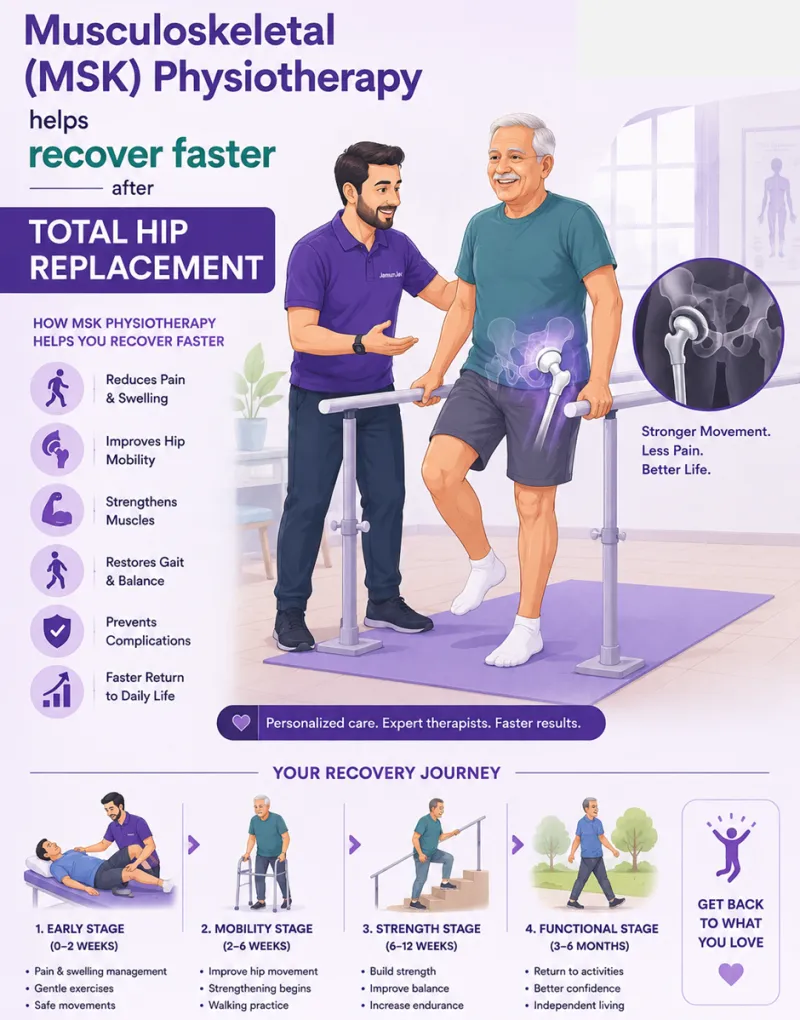
Total hip replacement (THR) is one of the most life-changing orthopaedic surgeries available — but the implant alone does not restore your mobility. The surgery replaces the damaged joint. Everything else — muscle strength, walking pattern, balance, and daily independence — has to be rebuilt through structured rehabilitation.
Physiotherapy after total hip replacement is not an optional add-on; it is the foundation of a successful outcome. Without it, patients risk a permanent limp, chronic joint stiffness, and unnecessary stress on the new implant. This week-by-week guide covers what to expect at each recovery phase, which exercises matter most, and how home physiotherapy is making post-THR rehabilitation more accessible across India.
Key Takeaways
- Physiotherapy after total hip replacement should begin within 24–48 hours of surgery with gentle positioning and ankle exercises.
- Recovery follows three phases: Weeks 0–2 (early mobility and pain management), Weeks 2–6 (strength and mobility gains), and Weeks 6–12 (functional training and return to daily activities).
- Hip abductor weakness is the most common cause of a post-THR limp — targeted strengthening exercises address this directly.
- Home physiotherapy is equally effective as clinic-based rehab for most recovery stages and is often safer in the early weeks when travel is difficult.
- Skipping physiotherapy significantly increases the risk of permanent gait problems, chronic stiffness, and implant stress.
- Most patients achieve functional independence within 6–12 weeks with consistent, guided rehabilitation.
Why Physiotherapy After Total Hip Replacement Is Non-Negotiable
The surgical team replaces the joint — the physiotherapy team rebuilds the function around it. Without structured rehabilitation, the muscles supporting the new joint remain weak, walking patterns stay altered, and the risk of long-term complications rises significantly. Here is what physiotherapy after total hip replacement specifically targets:
Strength Training
After THR surgery, patients commonly experience pain, swelling, stiffness, and difficulty walking. Targeted strengthening of the hip muscles, gluteal muscles, quadriceps, and core improves hip stability and supports movement, forming the foundation of a successful rehabilitation programme.
Mobility Exercises
Gentle range-of-motion exercises help reduce stiffness and progressively improve hip flexibility and functional movement. These exercises are introduced early and advanced carefully as the joint heals and the patient's tolerance increases.
Gait Retraining
THR surgery disrupts normal walking mechanics. Gait retraining helps patients regain a proper walking pattern, improve balance, and reduce compensatory movements that can place unnecessary stress on the new joint and surrounding structures.
Swelling Management
Elevation, ice therapy, and guided movements help reduce post-surgical swelling, improve circulation, and relieve pain in the early weeks after THR. Managing swelling effectively makes it easier to progress through the rehabilitation phases without unnecessary setbacks.
Week-by-Week Physiotherapy Timeline After Hip Replacement
Recovery after THR progresses in structured phases. Your age, overall health, surgical technique, and rehabilitation consistency all influence how quickly you move through each stage. Here is what to expect:
Weeks 0–2: Early Mobilisation and Pain Management
The first two weeks focus on pain management and safe early mobility. Key goals during this phase include:
- Gentle hip range-of-motion exercises
- Light strengthening exercises for the hip and thigh muscles
- Bed mobility, sit-to-stand transfers, and safe repositioning
- Short assisted walking sessions using a walker or other support
Physiotherapy during this phase is often more comfortable and effective when provided in a familiar home environment, helping reduce discomfort and fall risk after THR surgery. Physiotherapy at home in Mumbai and similar home-based services make this early phase considerably more manageable for patients.
Weeks 2–6: Strength and Mobility Gains
As the initial healing progresses, rehabilitation becomes more active:
- Increased range of motion and intensity of strengthening exercises
- Practice of sit-to-stand movements with improving control
- Gradual reduction in dependence on walking aids
- Introduction of more structured walking practice
Better adherence and steady progress during this phase is supported by structured plans provided by a physiotherapist at home, especially when outpatient clinic visits are difficult or inconvenient.
Weeks 6–12: Advanced Functional Training and Return to Daily Activities
By weeks 6 to 12, rehabilitation becomes more goal-oriented and functional:
- Balance and proprioception exercises to support dynamic movement
- Stair climbing technique training
- Longer walking distances and endurance-building activities
- Return to light daily activities and household tasks
Patients recovering from similar major joint surgeries — such as those following our guide on post-ACL reconstruction physiotherapy — often describe this phase as the most demanding yet most rewarding. Structured physiotherapy at home in Delhi, physiotherapy at home in Hyderabad, and other cities helps patients stay consistent and build confidence through this critical recovery window.
Essential Hip Strengthening and Gait Exercises After THR
Even after the acute recovery phases, ongoing strengthening and gait work remain essential for protecting the new joint and ensuring long-term mobility. These are the core exercise groups physiotherapists prioritise:
Hip Abductor and Extensor Strengthening
These muscles are critical for pelvic stability, a normal walking pattern, and overall hip joint support. Weakness in the hip abductors is the most common cause of a limp after THR — targeted exercises address this directly. For a broader understanding of how physiotherapy supports recovery, see our overview of types of physiotherapy and their benefits.
Gluteal and Hamstring Exercises
Strengthening the gluteal and hamstring muscles improves hip movement control, reduces the load on the replaced joint, and builds overall lower limb strength that supports daily activities.
Balance and Weight-Shifting Exercises
Functional balance exercises are essential for improving mobility and independence in daily life after THR. They reduce fall risk, improve confidence on uneven surfaces, and prepare patients for safe navigation of real-world environments such as stairs, ramps, and outdoor terrain.
Frequently Asked Questions
How soon after total hip replacement should physiotherapy begin?
Physiotherapy after total hip replacement should ideally begin within 24 to 48 hours of surgery, starting with gentle positioning, ankle pumps, and assisted sitting. Early mobilisation reduces the risk of blood clots, stiffness, and muscle atrophy. Your physiotherapist will guide the exact starting point based on your surgical approach and recovery condition.
Can I do physiotherapy at home after hip replacement?
Yes — home physiotherapy is a safe and effective option for most post-THR patients, especially in the first two weeks when travel to a clinic is difficult and fall risk is higher. A qualified physiotherapist visits your home, assesses your environment, and delivers the same clinical exercises in a safer, more comfortable setting. Many patients across India now prefer this approach for consistency and ease.
How long does full recovery from total hip replacement take?
Most patients achieve functional independence within 6 to 12 weeks. Full return to more demanding activities — confident stair climbing, longer walks, or recreational activities — can take up to 6 months. Recovery timeline varies based on age, pre-surgical fitness, and how consistently physiotherapy is followed.
Which exercises are most important after total hip replacement?
The most critical exercises target the hip abductors, gluteal muscles, and quadriceps — the muscle groups most weakened by THR surgery. Ankle pumps reduce blood clot risk in the early phase. Hip abductor strengthening corrects the post-THR limp. Balance and weight-shifting exercises restore everyday functional confidence. Your physiotherapist will progress these systematically based on your recovery stage.
What should I avoid after total hip replacement surgery?
In the early recovery phase, avoid bending the hip beyond 90 degrees, crossing your legs, and rotating the operated leg inward — these movements risk dislocating the new joint before surrounding soft tissue has stabilised. Your physiotherapist and surgeon will advise when these precautions can be relaxed, typically after 6 to 12 weeks depending on the surgical approach used.
Is physiotherapy after hip replacement available at home across India?
Yes — home physiotherapy for post-THR patients is available in major Indian cities including Delhi, Mumbai, and Hyderabad. These services bring qualified physiotherapists directly to your home, removing the challenge of clinic travel during the most critical phase of recovery.
What happens if I skip physiotherapy after hip replacement?
Skipping physiotherapy after total hip replacement significantly increases the risk of a permanent limp, chronic joint stiffness, muscle weakness, and excessive stress on the implant. Patients who miss structured rehabilitation are more likely to experience poor balance, reduced independence, and lower satisfaction with their surgical outcome. Early, consistent physiotherapy is one of the strongest predictors of long-term THR success.
Conclusion
Recovery from total hip replacement is not simply about surviving the surgery — it is about systematically rebuilding strength, gait, and independence. Physiotherapy after total hip replacement is the mechanism through which that rebuilding happens. Done consistently and correctly, it gives patients back their confidence, their walk, and their quality of life.
Whether you prefer clinic-based sessions or the convenience of supervised rehabilitation at home, consistent physiotherapy is what separates a good surgical outcome from a great one. Jamunjar's home physiotherapy services are available across Delhi, Mumbai, and Hyderabad — bringing expert rehabilitation directly to your recovery, at every stage. You may also find our guide on physiotherapy after knee replacement useful if you or someone you know is managing recovery from multiple joint conditions.
Medical Disclaimer
This article is for educational purposes only. It does not replace professional medical advice, diagnosis, or treatment. Always consult a qualified doctor or physiotherapist before starting, stopping, or changing any treatment for pain or medical conditions. Exercises should only be started after assessment and guidance from a qualified physiotherapist.
The article is written by

Dr Manasi Dake is a well-known Clinical Nutritionist and Dietician associated with Zen Multi Speciality Hospital. She has 10 years of experience in Clinical Nutrition and Dietetics and worked as an expert in different cities in India.