

Physiotherapy for Rotator Cuff & Shoulder Pain: Exercises, Stretches & Recovery Guide
Rotator cuff physiotherapy uses progressive loading, targeted stretches, and scapular strengthening to relieve shoulder pain and restore function — without surgery in most cases. Evidence-based rehabilitation produces lasting recovery.
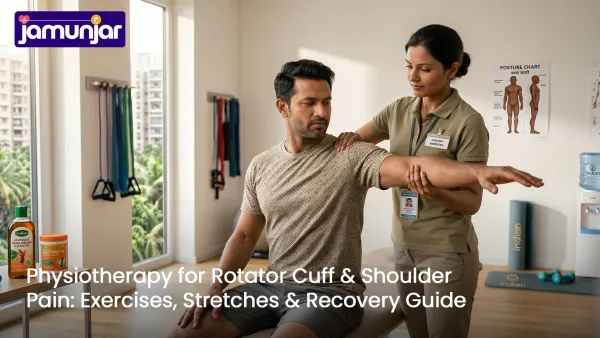
Medical note: This article is written for patient education only and does not replace assessment by an orthopaedic surgeon, sports medicine physician, or licensed physiotherapist.
Shoulder pain that makes it impossible to reach overhead, disrupts your sleep, or flares with every activity is one of the most debilitating musculoskeletal problems — and one of the most common in India. Rotator cuff physiotherapy is the first-line treatment recommended by clinical bodies worldwide, and research consistently shows that nonsurgical physiotherapy relieves pain and improves function in 80–85% of patients with rotator cuff injuries, including many with confirmed tears.
Yet many patients in India skip physiotherapy and either push through the pain or resort to painkillers, corticosteroid injections, or early surgery — all of which carry more risk and often deliver no better outcomes. This guide explains exactly how physiotherapy for rotator cuff and shoulder pain works at each stage of recovery, which exercises and stretches are appropriate (and when), and what the red flags are that require prompt medical attention.
Key Takeaways
- 80–85% of rotator cuff injuries improve with structured physiotherapy — surgery is not the default path.
- Rotator cuff physiotherapy follows a four-phase protocol: pain control → mobility → strengthening → return to activity.
- Stretches alone are not enough — recovery requires progressive strengthening of the rotator cuff and scapular muscles.
- Most patients achieve functional recovery in 8–16 weeks of supervised physiotherapy, depending on tear size and adherence.
- Red-flag symptoms — sudden inability to lift the arm, progressive weakness, or numbness — require urgent medical assessment, not home exercise.
- Internal links in this guide connect you to treatment types and signs you need physiotherapy for broader context.
Why Rotator Cuff Injuries Are So Common in India
The Anatomy of Rotator Cuff Pain
The rotator cuff is a group of four muscles — supraspinatus, infraspinatus, teres minor, and subscapularis — that wrap around the shoulder joint and hold the head of the humerus (arm bone) securely in the socket. They work together to control shoulder rotation and stabilise the joint during every arm movement. When these muscles or their tendons are overloaded, inflamed, partially torn, or fully torn, even simple tasks like combing your hair, placing a bag on an overhead shelf, or lying on your side at night become painful.
Shoulder pain is not one diagnosis. It can arise from rotator cuff tendinopathy, subacromial pain syndrome, partial or full-thickness tears, frozen shoulder (adhesive capsulitis), glenohumeral arthritis, cervical nerve referral, or instability. This is why a proper clinical assessment matters before any exercise plan is chosen. If your shoulder pain is recent, worsening, or following an injury, read our guide to 10 signs your body needs physiotherapy before starting any home programme.
Common Risk Factors in Indian Patients
- Age over 40 — rotator cuff tendon quality naturally decreases with age, making degenerative tears more common
- Heavy manual work — construction, farming, carrying heavy loads on one side
- Repetitive overhead activity — painting, cricket bowling, badminton smashing, plastering
- Desk work with poor posture — forward head position increases load on the supraspinatus tendon
- Sudden trauma — falls on an outstretched hand or direct shoulder impact
- Previous shoulder injury that was not fully rehabilitated
Rotator Cuff Physiotherapy: A Four-Phase Rehabilitation Roadmap
Well-designed rotator cuff physiotherapy follows a structured progression that matches your symptom stage and tear characteristics. Jumping straight to strengthening exercises when the shoulder is still inflamed, or staying in passive rest indefinitely, both delay recovery. Your physiotherapist will determine which phase you are in and progress you systematically. For an overview of the treatment modalities used alongside exercise, see our comparison of manual therapy, electrotherapy, and exercise therapy.
Phase 1 — Settle Pain and Protect the Tissue
The goal here is to reduce irritation without complete immobilisation. Activities include pendulum swings (passive gravity-assisted mobility), assisted active range-of-motion work with support, scapular setting exercises, and modalities such as ice after activity. This phase typically lasts 1–2 weeks for acute injuries, longer for flare-ups of chronic conditions.
Phase 2 — Restore Shoulder Mobility
Once pain has settled, mobility work increases. Table slides and wall climbs restore elevation gently. External rotation stretching in a supported position restores rotation. Postural correction drills address the forward head and rounded shoulder position that many Indian desk workers develop. This phase typically takes 2–4 weeks.
Phase 3 — Build Rotator Cuff and Scapular Strength
This is the core of recovery. Resistance band rows, side-lying external rotation with a light weight, serratus anterior activations, and lower trapezius strengthening progressively load the rotator cuff and scapular stabilisers. This phase requires patience — typically 4–8 weeks — because tendons adapt more slowly than muscles. The exercises should produce mild, acceptable soreness, not sharp or worsening pain.
Phase 4 — Return to Overhead Activity, Work, and Sport
The final phase reintroduces sport-specific or occupation-specific demands — progressive overhead lifting, throwing drills, endurance loading, and task-specific movement patterns. Return to full activity should be guided by demonstrated strength and pain-free function, not simply by the absence of pain at rest. Most patients complete Phase 4 between 8 and 16 weeks after starting physiotherapy, depending on the severity of injury and consistency of home exercises.
Rotator Cuff Stretches and Strengthening Exercises
The following exercises are commonly used in supervised rotator cuff rehabilitation. Stretching alone is not sufficient — the programme must combine mobility work with progressive loading, because the goal of rotator cuff physiotherapy is to make the shoulder tolerate daily and overhead activity again, not just feel temporarily looser.
Key Rotator Cuff Stretches
- Pendulum swings — gentle early mobility; the hanging weight of the arm creates traction that reduces muscle guarding
- Table slides and wall climbs — graded way to restore overhead elevation without forcing painful range
- Crossover stretch (horizontal adduction) — stretches the posterior shoulder capsule; useful when there is tightness at the back of the shoulder
- Sleeper stretch — side-lying internal rotation stretch for posterior shoulder tightness; should never be forced into pain
- External rotation stretch with arm at side — gently improves rotation range when the shoulder is not irritable
Key Rotator Cuff Strengthening Exercises
- Side-lying external rotation — 2–3 sets of 15 reps with a light weight (0.5–2 kg); directly targets the infraspinatus and teres minor
- Resistance band rows — activates the lower trapezius and rhomboids; improves scapular positioning
- Serratus anterior activation (wall press-plus) — essential for smooth overhead motion and preventing winging of the shoulder blade
- Side-lying full-can exercise — targets the supraspinatus in a safer arc than the traditional empty-can position
- Prone Y, T, and W exercises — excellent for lower and middle trapezius once the shoulder is stronger
If you are also managing neck stiffness or tension that contributes to your shoulder pain, read our guide on physiotherapy for neck and shoulder stiffness from mobile and laptop use.
Recognising a Rotator Cuff Problem — and When to Act
Typical Signs of Rotator Cuff Injury
- Pain when lifting the arm overhead or lowering it from an elevated position
- Night pain that disrupts sleep, especially lying on the affected side
- Weakness during shoulder rotation or elevation
- A painful arc — pain between approximately 60° and 120° of shoulder elevation that eases above and below this range
- Stiffness in the morning that gradually loosens with movement
Red-Flag Symptoms That Need Urgent Medical Assessment
- Sudden inability to lift the arm after a fall or impact — possible significant tear, fracture, or dislocation
- Visible deformity, severe swelling, or extreme pain after an injury
- Progressive weakness or the arm dropping uncontrollably
- Fever, skin colour changes, or unexplained systemic symptoms — may indicate infection or inflammatory disease
- Numbness, tingling, or pain radiating from the neck into the arm — suggests cervical nerve involvement rather than isolated rotator cuff pathology
If you are unsure whether your shoulder needs physiotherapy, an orthopaedic surgeon, or a chiropractor, our guide to physiotherapy vs chiropractor vs orthopaedic explains when to see which specialist.
Shoulder Pain Management at Home
A practical home management plan during physiotherapy includes:
- Activity modification — reduce, but do not eliminate, arm use; avoid repeated painful overhead loading
- Short, regular exercise sessions — 10–15 minutes twice daily is more effective than one long session per week
- Ice after activity if it reduces your specific pain (typically 10–15 minutes, wrapped in a cloth)
- Posture correction — sit tall, keep the shoulder blade gently retracted, and avoid prolonged forward head posture
- Sleeping position — avoid lying on the affected shoulder; try sleeping on your back or with a pillow supporting the arm
Home physiotherapy services are available in Mumbai, Delhi, and Hyderabad for patients who cannot travel to a clinic. A visiting physiotherapist can check your exercise technique at home and adjust your programme as recovery progresses. For broader questions about managing chronic pain through physiotherapy rather than painkillers, see our guide to physiotherapy vs painkillers for long-term pain relief.
Frequently Asked Questions
Can a rotator cuff tear heal without surgery?
Yes — many symptomatic rotator cuff tears respond well to physiotherapy without surgery. The American Academy of Orthopaedic Surgeons (AAOS) notes that nonsurgical treatment relieves pain and improves function in approximately 80–85% of patients. The decision depends on tear size, how the tear happened, the degree of weakness, patient age, and activity goals. Partial tears and many small-to-medium full-thickness tears in patients who are not competitive athletes are generally managed conservatively first. Surgery is considered after a minimum of 6 months of consistent conservative treatment fails to produce adequate improvement.
Are rotator cuff stretches enough for recovery?
No. Stretches restore mobility but do not rebuild the tendon's load tolerance or the muscles' strength. A complete rotator cuff physiotherapy programme must include progressive strengthening, scapular stability training, and graded loading alongside mobility work. Patients who focus only on stretching often find that pain returns as soon as they return to activity. The strengthening component is what makes recovery sustainable.
How long does rotator cuff physiotherapy take?
Most patients with mild to moderate rotator cuff injuries achieve significant functional improvement in 8–12 weeks of structured physiotherapy (typically 12–16 sessions combined with daily home exercises). Chronic or severe cases, or those with large tears, may require 4–6 months of rehabilitation. The single most important factor in recovery speed is consistency with the home exercise programme between clinic sessions.
Which exercises are best for rotator cuff pain?
The most effective exercises combine targeted rotator cuff strengthening with scapular stability work. Side-lying external rotation, resistance band rows, serratus anterior activations, and lower trapezius strengthening form the core of most evidence-based protocols. Stretches such as the pendulum, sleeper stretch, and wall climb are useful for restoring mobility. The exact selection depends on your specific diagnosis, stage of healing, and pain level — which is why physiotherapy should be supervised rather than copied from generic online videos.
Can I do shoulder exercises at home in India?
Yes — home exercises are an essential part of rotator cuff rehabilitation, but the programme works best when a physiotherapist has first assessed your shoulder, taught you the exercises correctly, and set appropriate load targets. Home physiotherapy services are widely available in Indian cities including Mumbai, Delhi, and Hyderabad. A physiotherapist visiting your home can observe your technique, check your posture during exercises, and adjust the programme as your strength improves.
Is physiotherapy or surgery better for a rotator cuff tear?
For most patients, physiotherapy is the recommended first-line approach. Surgery is generally reserved for traumatic tears with marked weakness, tears that fail to improve after consistent conservative treatment, or patients with specific functional demands (such as overhead athletes). Studies consistently show that well-supervised physiotherapy achieves comparable outcomes to surgery in many patient groups, with fewer risks and shorter total recovery time. Discuss the specifics of your tear with your orthopaedic surgeon and physiotherapist together before deciding.
Does physiotherapy for shoulder pain also help with elbow pain?
Shoulder and elbow problems often overlap because they share the same kinetic chain — the shoulder's stability and mechanics directly influence forearm load. Physiotherapy addresses this chain comprehensively. If you also have elbow pain from repetitive use, our guide to physiotherapy for tennis elbow and golfer's elbow covers the rehabilitation approach for the elbow specifically.
Conclusion
Rotator cuff physiotherapy is not a passive process. It requires structured, progressive rehabilitation matched to your diagnosis — from pain control and mobility work in the early weeks, through targeted strengthening and scapular training, to a fully supervised return to activity. Most patients who commit to a proper programme recover well without surgery.
If chronic pain, fatigue, or metabolic factors are contributing to your recovery, the Metabolic Reset Program addresses these underlying health drivers alongside your physical rehabilitation.
Do not let shoulder pain become a permanent limitation. Early, expert physiotherapy intervention produces the best outcomes — and for most people, it produces full recovery.
Medical Disclaimer
This article is for educational purposes only and is not a substitute for individualised medical advice, diagnosis, or treatment. Always consult a qualified physiotherapist or doctor before starting any exercise programme for shoulder pain.
References
- American Academy of Orthopaedic Surgeons (AAOS). Rotator Cuff Tears [Internet]. OrthoInfo. [Accessed 2026].
Available from: https://orthoinfo.aaos.org/en/diseases--conditions/rotator-cuff-tears/ - American Academy of Orthopaedic Surgeons (AAOS). Management of Rotator Cuff Injuries: Evidence-Based Clinical Practice Guideline [Internet]. [Accessed 2026].
Available from: https://www.aaos.org/rccpg - Steuri R, et al. Exercise therapy for rotator cuff-related shoulder pain: a systematic review and meta-analysis. British Journal of Sports Medicine. 2017;51(18):1340.
Available from: https://bjsm.bmj.com/content/51/18/1340 - National Health Service (NHS). Shoulder Pain [Internet]. [Accessed 2026].
Available from: https://www.nhs.uk/symptoms/shoulder-pain/
The article is written by

He specializes in comprehensive assessment, pre- and post-rehabilitation, and advanced management of musculoskeletal, neurological, and critical cardio-respiratory conditions.