

Post-ACL Reconstruction Physiotherapy: A Complete Recovery Guide from Surgery to Return to Sport
ACL reconstruction is only the first step. Recovery depends on a structured, criteria-based physiotherapy plan that restores motion, reduces swelling, rebuilds strength, retrains movement control, and supports safe return to daily activity and sport.
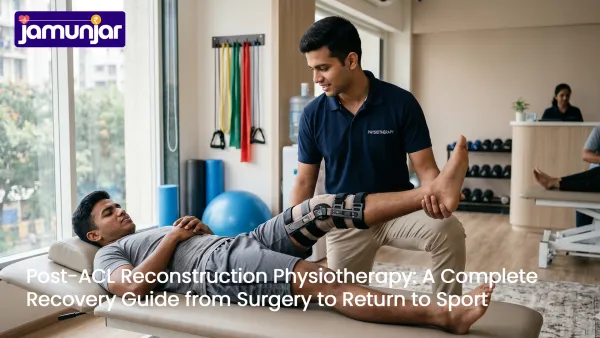
Anterior cruciate ligament (ACL) reconstruction is common, but surgery alone does not restore full knee function. The real work begins after the operation, when the graft must be protected while motion, strength, balance, and movement quality are rebuilt in a staged manner. Current orthopedic guidance and sports medicine literature consistently emphasise that rehabilitation should be criteria-based rather than driven only by the calendar.
For readers searching for the ACL full form in medical contexts, ACL stands for anterior cruciate ligament. In this article, the overall ACL rehabilitation protocol is explained as a staged ACL physiotherapy protocol rather than a one-size-fits-all exercise plan.
That distinction matters because the knee can feel better long before it is ready for running, jumping, or cutting. A patient who is pain-free but still weak, swollen, or unstable may appear recovered while still carrying a meaningful risk of reinjury. The goal of physiotherapy after ACL surgery is not just to reduce pain; it is to restore confidence, mechanics, and long-term knee health.
Post-ACL reconstruction physiotherapy is a staged recovery process that starts with swelling control and full knee extension, then progresses through quadriceps activation, gait normalisation, strengthening, neuromuscular training, running, and return-to-sport testing. Progress should be based on function, not time alone.
For older patients undergoing ACL reconstruction, a full body checkup for elderly before beginning rehabilitation can help the physiotherapist and surgeon understand cardiovascular tolerance, bone health, and any comorbidities that may affect the recovery plan.
Key Takeaways
- ACL rehabilitation should be phase-based and criteria-based, not just time-based.
- Full extension in the first two weeks is one of the most critical early milestones — missing it leads to stiffness and delayed progress.
- Quadriceps strength, movement quality, and swelling control are central to good outcomes at every phase.
- Return to sport after ACL should depend on objective testing — strength symmetry, hop tests, and movement quality — not confidence alone.
- Rushing progression increases reinjury risk; consistent, criteria-based progression is what improves long-term outcomes.
- Structured physiotherapy — whether clinic-based or at home — is the difference between a recovery that stalls and one that returns you fully to sport.
Quick Answer
ACL Recovery Timeline (Physiotherapy-Based)
- Weeks 0-2: Focus on swelling control, full knee extension, and quadriceps activation
- Weeks 2-6: Improve knee bending, normalise walking, and begin light strengthening
- Weeks 6-12: Build strength, balance, and single-leg control
- Months 3-6: Start running, jumping, and controlled movement training
- Months 6-9+: Return to sport with strength symmetry, functional testing, and medical clearance
Recovery should be criteria-based (function and strength) rather than time alone, as healing varies between individuals.
Medical note: This article is written for patient education and clinical guidance. It does not replace assessment by an orthopedic surgeon or licensed physiotherapist.
ACL Rehabilitation Roadmap at a Glance
Before surgery, ACL prehab and simple ACL prehab exercises such as heel props and gentle ACL stretches help reduce swelling and prepare the knee for surgery.
| Phase | Typical Time Frame | Main Goal | What Success Looks Like |
|---|---|---|---|
| Prehab | Before surgery | Reduce swelling and restore motion | Full extension, near-normal walk, calm knee |
| Phase 1 | 0-2 weeks | Protect graft and restore control | Extension, quad activation, swelling reduction |
| Phase 2 | 2-6 weeks | Regain motion and basic function | Better flexion, better gait, better control |
| Phase 3 | 6-12 weeks | Rebuild strength and balance | Single-leg control, stronger quads and hips |
| Phase 4 | 3-6 months | Return to running and jumping | Pain-free straight-line running, safe landing |
| Phase 5 | 6-9+ months | Return to sport | Strength symmetry, hop tests, movement quality |
Why ACL Physiotherapy Matters After Reconstruction
The ACL does more than stabilise the knee in a simple forward-backward sense. It helps control rotational load, supports coordinated lower-limb movement, and contributes to the sense of joint position known as proprioception. After injury and reconstruction, those functions do not automatically return just because the graft has been placed. Rehabilitation must retrain the whole system: swelling response, muscle activation, balance, landing mechanics, and confidence.
A well-designed set of ACL rehab phases reduces common postoperative problems such as stiffness, persistent swelling, quadriceps inhibition, poor gait mechanics, and premature return to sport. Modern protocols now emphasise early motion, appropriate weight-bearing, progressive strengthening, and functional testing before clearance to higher-level activity.
Graft Healing: Why the Rehab Timeline Cannot Be Rushed
A useful way to understand ACL rehabilitation is to think in terms of biology rather than just exercise. After reconstruction, the graft goes through an early inflammatory phase, a proliferative phase, and a much longer remodeling or ligamentisation phase. Experimental and clinical reviews show that the graft-bone interface and intra-articular ligamentisation take months, which is why strength and sport loading must be advanced carefully.
In practical terms, this means the knee may look good before the graft is truly mature. That is one reason return-to-sport decisions should never rely on pain alone. Even if swelling is low and walking feels normal, the graft and surrounding neuromuscular system may still be adapting to load.
Graft Types and Recovery Considerations
- Patellar tendon graft (BPTB): often associated with stronger fixation but may cause more anterior knee pain or kneeling discomfort early in recovery.
- Hamstring tendon graft: may require extra attention to hamstring strength recovery, especially for athletes who depend on sprinting or acceleration.
- Quadriceps tendon graft: may be useful in selected patients, but quadriceps loading must be progressed intelligently because knee extensor recovery is central to function.
The precise rehab programme should always be individualised to the graft type, surgeon preference, meniscal work if any was performed, and the patient`s sport or activity goal.
Phase 1 Recovery: Protect the Knee and Restore Control
The first two weeks of ACL surgery recovery timeline are about creating the right environment for healing. The core goals are to reduce swelling, regain full knee extension, restore quadriceps activation, and begin walking with good mechanics when permitted. AAOS guidance and sports rehabilitation literature both emphasise that early extension and controlled motion are essential.
Swelling is not just a symptom; it actively suppresses quadriceps function. A knee that remains puffy and painful will not activate normally, which is why ice, elevation, compression, and sensible activity modification are so important. Early physiotherapy in knee ligament surgery recovery is often modest in volume but high in value. The point is not to train hard. The point is to move the knee enough to prevent stiffness while respecting tissue healing.
What Phase 1 Usually Includes
These early ACL recovery exercises are the simplest ACL physiotherapy exercises used in the first week after ACL surgery. They are part of an early PT for ACL tear approach that protects the graft while restoring control.
- Heel props or supported extension work to regain full straightening
- Quad sets and straight-leg raises to restore muscle activation
- Heel slides or assisted bends to improve flexion gradually
- Ankle pumps and gentle circulation work to reduce swelling
- Crutch-assisted walking if prescribed, with a focus on even weight bearing
A critical early milestone is full extension. If extension is missed in the first phase, later gait problems, stiffness, and delayed strengthening become much harder to reverse.
Early Warning Signs That Need Clinical Review
- Swelling that increases rather than steadily improving
- A knee that cannot straighten despite exercises
- Marked quadriceps inhibition or a strong extensor lag
- Worsening pain, redness, fever, or wound discharge
Patients in Mumbai who need early hands-on assessment and graft monitoring can visit a physiotherapy center in Mumbai to ensure the first two weeks of recovery are supervised correctly.
Weeks 2-6: Restore Motion and Normalize Walking
Once swelling settles and extension improves, rehabilitation shifts toward motion, gait normalisation, and low-load strengthening. This stage is often where patients feel they are making quick progress, but the graft is still biologically vulnerable. That is why the best programmes stay conservative with impact loading while gradually increasing control.
The aim now is a clean walking pattern without limping, a more complete knee bend, and enough muscle control to support daily life. Many patients underestimate how important gait retraining is. A subtle limp is not harmless: it can create compensation patterns in the hip, back, and opposite leg, making later sport progression harder.
Typical Exercises in This Stage
In practice, these movements are still foundational ACL rehab exercises and also function as ACL strengthening exercises once the knee is ready for more load.
- Stationary bike when knee bend allows
- Mini-squats with excellent alignment
- Supported step-ups
- Bridging and hip stability work
- Gentle hamstring loading, if cleared
Movement quality matters more than quantity here. A small number of well-controlled repetitions is more valuable than a large number of poorly executed ones.
Weeks 6-12: Strength, Balance, and Neuromuscular Control
This is the rebuilding phase. Pain is often lower, the knee feels more usable, and patients become tempted to do more. That is exactly why this phase deserves close supervision. Strength deficits, especially in the quadriceps, are common after ACL reconstruction and can persist long after pain has improved. Peer-reviewed studies show that quadriceps weakness remains a major barrier to function and a contributor to poor outcomes.
The knee must also relearn how to control itself dynamically. This is why balance training, single-leg work, and neuromuscular exercises matter. The ACL is not just a passive band of tissue; it also participates in sensory feedback. After injury and surgery, that feedback loop is disrupted, so rehab must retrain the knee to respond quickly and symmetrically under load.
Strength Priorities
- Quadriceps as the main recovery priority
- Hamstrings for posterior-chain support
- Gluteal muscles for hip and pelvis control
- Calf strength for lower-limb endurance and landing support
Balance and Control Drills
By phase 3, ACL rehab exercises focus on strength symmetry, single-leg control, and low-impact movement quality. These are the foundation for later ACL training, including more demanding sport preparation.
- Single-leg stance progressions
- Foam or unstable-surface balance work
- Step-down control with knee alignment
- Perturbation drills to train reflexive stability
Progress should be criteria-based. Before advancing, the patient should show minimal swelling, full or near-full range of motion, acceptable single-leg control, and measurable improvement in strength symmetry.
For patients in Delhi who find clinic visits difficult during this demanding phase, physiotherapy at home in Delhi can keep the strengthening and balance programme on track without disrupting daily routine.
Months 3-9+: Running, Jumping, and Return to Sport
The advanced phase is where physiotherapy becomes sport-specific. Many patients feel near normal by this stage, but that feeling can be misleading. The literature shows that returning too early to pivoting or contact sport substantially increases reinjury risk, especially in young athletes. In a landmark decision-rule study, returning to sport at nine months or later and restoring quadriceps symmetry reduced reinjury risk.
This is also the stage where objective testing becomes essential. Hop tests, strength testing, movement analysis, and psychological readiness all matter. Importantly, hop distance alone is not enough; recent reviews caution that symmetry on a hop test can hide poor landing mechanics. The knee must not only perform; it must perform well.
When Running Usually Begins
Running is usually introduced only after the knee is quiet, mobile, and strong enough to tolerate higher loading. Typical readiness markers include no reactive swelling, full extension, adequate flexion, good single-leg control, and physician or physiotherapist clearance.
- Start with brisk walking and short straight-line jogging
- Increase duration before speed
- Add direction changes only after clean straight-line mechanics are established
Jumping, Landing, and Agility
Jumping and landing are central to ACL rehab because they recreate the loading patterns that often trigger injury in sport. Patients must learn to land softly, keep the knee aligned over the foot, and avoid inward knee collapse. Agility drills then add acceleration, deceleration, and change-of-direction demands.
A common mistake is to focus on speed before control. In this phase, the patient should first show stable mechanics in a slow drill before any attempt is made to perform the same task faster. This conservative approach is one reason modern return to sport after ACL pathways are safer than simple time-based clearance.
Return-to-Sport Criteria
- No or minimal swelling
- Full range of motion
- Strength symmetry approaching 90% or better
- Passing hop and functional performance tests
- Good landing and cutting mechanics
- Confidence to perform sport-specific tasks without hesitation
Patients in Hyderabad continuing sport-specific training can use physiotherapy at home in Hyderabad to maintain session consistency during the later stages of return-to-sport preparation.
The message is simple: feeling ready is not the same as being ready. Clearance should be based on function, testing, and clinical judgement, not on optimism alone.
Complications, Red Flags, and When to Reassess
After ACL reconstruction, common complications include arthrofibrosis (excessive stiffness), persistent quadriceps inhibition, cyclops lesion, graft failure, meniscal irritation if a meniscal procedure was performed, and delayed return of confidence. While not every case is avoidable, many are easier to prevent than to treat once established.
Red flags deserve special attention. Severe swelling that does not settle, sudden instability, a knee that locks or cannot straighten, calf pain with swelling, fever, wound drainage, or a major setback after a twist all warrant prompt review. Educating patients about these warning signs is a major part of responsible orthopedic rehabilitation aftercare.
For patients with multiple risk factors or a slower-than-expected recovery, an advanced full body checkup can help identify underlying issues such as vitamin deficiencies, metabolic concerns, or cardiovascular factors that may be affecting healing.
Practical Do's and Don'ts
- Do: Attend post operative physiotherapy consistently, prioritise extension, and progress only when swelling and strength permit.
- Do: Keep exercises clean and controlled, especially in the first 12 weeks.
- Do: Report worsening pain, swelling, locking, or instability early.
- Don't: Rush back to running or sport because the calendar says you should.
- Don't: Ignore limping, even if it seems mild.
- Don't: Use other athletes as your recovery benchmark; ACL rehab is highly individual.
Nutrition and Supportive Care During Recovery
Rehabilitation is strongest when the body has enough nutritional support to adapt to training. Adequate protein intake supports muscle repair, while overall energy sufficiency helps the patient tolerate progressive exercise. Many clinicians also pay attention to vitamin D status, general bone health, and hydration when recovery feels slower than expected. These are supportive measures, not shortcuts, but they do matter.
For patients managing recovery from home, structured support such as post operative physiotherapy or physiotherapy at home in Mumbai can help maintain adherence without making the process feel disruptive. Similar home-based options are available in Delhi and Hyderabad when travel is difficult.
If broader monitoring is clinically useful, home sample collection can make follow-up testing easier without unnecessary travel.
Even 1 year post ACL surgery, exercises should still include maintenance strength work for the quadriceps, hamstrings, and hips if the patient wants to keep the knee resilient.
Frequently Asked Questions
How long does ACL rehabilitation take?
Most patients need about 6 to 9 months to return to higher-demand sports, and some need longer. The exact timeline depends on the graft type, whether other structures were repaired, the quality of physiotherapy, and the patient`s strength and movement recovery.
Women recovering from ACL reconstruction, who statistically face higher reinjury risk, may also benefit from a women's full body checkup to monitor bone density, hormonal health, and overall recovery readiness.
When can I start walking normally after surgery?
Walking starts early, often with crutches if the surgeon recommends them. The goal is to restore a normal gait as soon as it is safe, but only after swelling, pain, and quadriceps control improve enough to support clean mechanics.
When can I start running?
Running usually begins only after full extension, minimal swelling, good single-leg control, and adequate strength are restored. For many patients, that falls somewhere around 3 to 4 months, but readiness matters more than the calendar.
Why is my quadriceps still weak?
Quadriceps weakness is common after ACL reconstruction because swelling, pain, and altered nerve signalling suppress muscle activation. This is one reason early and consistent physiotherapy is so important.
Can I skip physiotherapy if I feel fine?
No. Feeling fine does not mean the knee has regained its strength, neuromuscular control, or sport readiness. The literature on ACL rehabilitation consistently shows that functional deficits can persist after symptoms improve.
What are signs that I am doing too much too soon?
Increasing swelling after exercise, persistent pain, instability, repeated limping, or reduced motion after a session are all signs that the load is too high. The solution is usually to step back and reassess, not to push through.
Is home-based physiotherapy effective?
It can be, provided it is structured, supervised, and progressive. Many patients do well when the programme is individualised and adherence is high, particularly when travel or mobility is difficult.
What happens if I do not complete full rehab?
Incomplete rehabilitation can leave a patient with weakness, poor movement quality, lower confidence, and a higher risk of reinjury or long-term knee problems. Rehab is a core part of the treatment, not an optional add-on.
Conclusion
ACL reconstruction sets the stage, but physiotherapy writes the story of recovery. Every phase — from swelling control in week one to return-to-sport testing at nine months — builds on the last, and no phase can safely be skipped. The goal is not just a pain-free knee. It is a knee that performs reliably under the demands of real life, sport, and long-term activity.
Whether you are early in recovery or preparing to return to sport, structured support makes a measurable difference. Explore post-operative physiotherapy and orthopaedic rehabilitation options to ensure your recovery is clinically guided from start to finish. If in-person visits are difficult, physiotherapy at home in Mumbai, physiotherapy at home in Delhi, and physiotherapy at home in Hyderabad can bring professional guidance directly to you.
References
- American Academy of Orthopaedic Surgeons (AAOS). Management of Anterior Cruciate Ligament Injuries: Clinical Practice Guideline. 2022.
- Kotsifaki R, et al. Aspetar clinical practice guideline on rehabilitation after anterior cruciate ligament reconstruction. British Journal of Sports Medicine. 2023;57:500-514.
- Brinlee AW, et al. ACL Reconstruction Rehabilitation: Clinical Data, Biologic Healing, and Return to Sport Considerations. 2021.
- Yao S, et al. Graft healing after anterior cruciate ligament reconstruction. 2021.
- Grindem H, et al. Simple decision rules can reduce reinjury risk by 84% after ACL reconstruction: the Delaware-Oslo ACL cohort study. 2016.
- Kotsifaki A, et al. Single leg hop for distance symmetry masks lower limb biomechanics. British Journal of Sports Medicine. 2022.
- Schwery NA, et al. Quadriceps Strength following Anterior Cruciate Ligament Reconstruction. 2022.
- West TJ, et al. Unilateral tests of lower-limb function as prognostic indicators of future knee health after ACL injury and reconstruction. British Journal of Sports Medicine. 2023.
- Golberg E, et al. Anterior Cruciate Ligament Reconstruction Return-to-Sport Timing and New Injury Risk. 2023.
- Paschos NK. Anterior cruciate ligament reconstruction: principles of treatment. 2017.
Disclaimer
This article is educational and is not a substitute for individualised medical advice, diagnosis, or treatment. Always consult a qualified orthopaedic surgeon or licensed physiotherapist for guidance specific to your condition and recovery.
The article is written by

He specializes in comprehensive assessment, pre- and post-rehabilitation, and advanced management of musculoskeletal, neurological, and critical cardio-respiratory conditions.