

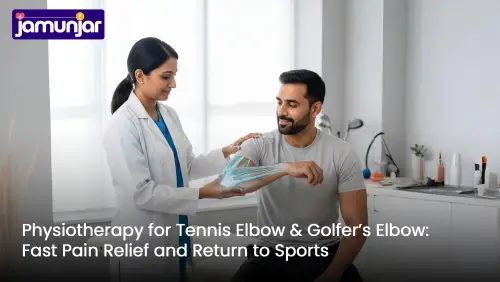
Physiotherapy for Tennis Elbow & Golfer's Elbow: Fast Pain Relief and Return to Sport
Physiotherapy for tennis elbow and golfer's elbow targets the root cause — tendon overuse — using progressive loading exercises that reduce pain, restore grip strength, and help you return to sport safely.
Medical Disclaimer: This article is for educational purposes only and does not replace professional medical advice. Always consult a qualified physiotherapist or doctor before starting any treatment or exercise programme.
Elbow pain that flares up every time you grip a racquet, type at a keyboard, or lift a cup of chai — and refuses to settle — is often more than just muscle soreness. Physiotherapy for tennis elbow and golfer's elbow is the most evidence-based treatment available for these tendon conditions, and the sooner you start structured rehabilitation, the faster your recovery.
Tennis elbow (lateral epicondylitis) affects the outer elbow, while golfer's elbow (medial epicondylitis) affects the inner elbow. Despite their sporty names, both conditions are common in office workers, homemakers, and anyone doing repetitive arm or wrist movements — not just athletes. This guide explains exactly how physiotherapy for tennis elbow works, what to expect at each stage of recovery, and when you can realistically return to sport or full activity.
Key Takeaways
- Tennis elbow affects the outer elbow; golfer's elbow affects the inner elbow — both respond well to physiotherapy with progressive loading.
- Isometric exercises can reduce pain within days; most patients see significant improvement within 6–12 weeks of structured physiotherapy.
- Exercise therapy is the gold standard — bracing and taping are supportive tools only, not replacements for rehabilitation.
- Return to sport should be based on restored grip strength and function, not simply on pain going away.
- Untreated tennis or golfer's elbow can become chronic, so early physiotherapy intervention produces the best outcomes.
- Most patients achieve full recovery in 8–12 structured sessions for mild to moderate cases.
Why Tennis Elbow and Golfer's Elbow Develop — Even Without Playing Sports
The Mechanics of Tendon Overload
Both conditions are classified as tendinopathies — a term that means the tendon tissue has been overloaded beyond its natural healing capacity. This is not simply inflammation; it involves actual structural changes within the tendon. Repeated gripping, lifting, typing, or using tools places cumulative stress on the forearm muscles that attach near the elbow. When the workload exceeds what the tendon can handle, it begins to break down at a microscopic level, causing pain, weakness, and loss of grip strength.
Technique faults in sports such as cricket, badminton, tennis, or golf can concentrate forces on specific parts of the elbow tendon. Similarly, poor workstation setup — typing with wrists bent, or repeated awkward lifting — can produce the same effect in non-athletes.
Common Risk Factors in Indian Patients
- IT and desk workers spending more than 6 hours daily at a keyboard or mouse
- Homemakers doing repetitive kneading, chopping, and lifting tasks
- Cricket players and badminton enthusiasts with poor stroke technique or sudden increases in training load
- Construction and factory workers using hand tools repeatedly
- Anyone returning to physical activity after a long break — the tendon loses conditioning and is more vulnerable to overload
Physiotherapy for Tennis Elbow and Golfer's Elbow: The MSK Protocol
Evidence-based MSK physiotherapy for elbow tendinopathies focuses on progressive loading rather than prolonged rest. Rest alone rarely resolves tendinopathy — the tendon needs carefully graded exercise to rebuild its structural integrity. A qualified physiotherapist will assess your specific stage of injury and design a programme accordingly. For more on how this compares with other treatment types, see our guide to manual therapy, electrotherapy, and exercise therapy.
Phase 1 — Isometric Exercises for Immediate Pain Relief
In the acute phase, isometric contractions (held, static contractions without movement) are the safest starting point. Research shows that isometrics can produce immediate, measurable pain relief by calming the nervous system's response to load. A typical protocol involves holding a gentle wrist extension or flexion contraction for 30–45 seconds, repeated 4–5 times, with minimal discomfort during the exercise.
Phase 2 — Eccentric Loading for Tendon Repair
Eccentric exercises — where the muscle lengthens under load — are central to tendon rehabilitation. Slow, controlled eccentric wrist extensions or flexions place therapeutic stress on the damaged tendon, stimulating repair and improving load tolerance. These are typically introduced once the isometric phase is well-tolerated. They should always be performed under physiotherapist guidance, as the progression speed matters enormously. Doing too much too soon causes setbacks; doing too little prolongs recovery unnecessarily.
Phase 3 — Manual Therapy and Mobility Work
Soft-tissue techniques and joint mobilisation at the elbow, wrist, and even the cervical spine can improve local circulation, reduce muscle tightness, and support the active loading programme. Manual therapy is most effective as a complement to exercise — not as a standalone treatment. Your physiotherapist may also assess shoulder stability, posture, and overall movement patterns, since restrictions elsewhere in the kinetic chain can contribute to elbow overload. If you are wondering whether physiotherapy is right for your pain, read about physiotherapy vs painkillers for long-term pain relief.
Sports-Specific Strengthening and Return-to-Play Timelines
A safe return to sport is not simply about waiting for the pain to ease — it requires demonstrated improvement in grip strength, endurance, and neuromuscular control. Returning too early is the most common reason for relapse.
Recovery Milestones and Realistic Timelines
- Mild cases: Significant improvement within 6–8 weeks with consistent home exercises
- Moderate cases: Full recovery typically in 8–12 weeks with structured physiotherapy (approximately 8–12 sessions)
- Chronic cases (symptoms lasting more than 3 months): Longer-term management of 3–6 months, focused on load tolerance and gradual sport reintegration
Athletes returning to racquet sports, cricket, or badminton should progress through light shadow practice, then resisted sport-specific drills, before returning to full competitive play. For a broader picture of post-injury physiotherapy, see our guide to rotator cuff and shoulder pain rehabilitation.
Functional Grip Training for Sustained Recovery
Grip endurance and wrist coordination are essential for preventing recurrence. Progressive grip loading — using resistance bands, light weights, or grip trainers — is generally far more effective than avoidance. Your physiotherapist will help you identify the specific demands of your sport or occupation and design grip training that matches those requirements.
Bracing vs Taping vs Exercise: What the Evidence Shows
Passive supports are commonly used for elbow tendon pain, but they are supportive tools — not treatments. Used alone without rehabilitation, they frequently lead to persistent pain and recurrence.
When Bracing and Taping Help
- Counterforce braces may reduce tendon load during specific activities in the short term and can make daily tasks more comfortable while the tendon heals.
- Taping can improve proprioception (your body's sense of elbow position) and reduce discomfort during activities. Its effects are generally short-term and most useful in the early phase.
- Both work best as temporary adjuncts to an active exercise programme — not as standalone treatments.
Why Exercise Therapy Is the Gold Standard
Exercise therapy is consistently rated as the most effective long-term approach for elbow tendinopathies in clinical guidelines. Progressive strengthening corrects the underlying tendon weakness, movement correction addresses contributing biomechanical factors, and load management ensures recovery is sustainable. Relying only on a brace without proper physiotherapy for tennis elbow or golfer's elbow significantly increases your risk of the condition becoming chronic. To understand the full spectrum of physiotherapy treatments available, see our comparison of physiotherapy treatment types.
Red-Flag Symptoms That Need Urgent Medical Attention
Most elbow pain is mechanical and responds well to physiotherapy. However, see a doctor urgently if you experience any of the following:
- Sudden severe pain after a fall, direct impact, or audible pop at the elbow
- Progressive weakness or inability to extend or grip with the hand
- Numbness or tingling spreading into the forearm, hand, or fingers
- Visible swelling, redness, or heat around the elbow joint suggesting infection or fracture
- Elbow pain combined with unexplained weight loss, night sweats, or fever — these can indicate systemic conditions
If you are unsure whether your symptoms need physiotherapy or a doctor first, our guide to 10 signs you need physiotherapy can help clarify.
Frequently Asked Questions
What is the difference between tennis elbow and golfer's elbow?
Tennis elbow (lateral epicondylitis) causes pain on the outer side of the elbow and is caused by overuse of the wrist extensor muscles. Golfer's elbow (medial epicondylitis) causes pain on the inner side and involves the wrist flexor muscles. Both are tendinopathies caused by repetitive overload, and both respond to the same evidence-based physiotherapy approach of progressive loading. You do not need to play tennis or golf to develop either condition — they are common in office workers, homemakers, and manual labourers.
How many physiotherapy sessions do I need for tennis elbow?
For mild to moderate cases, most patients see substantial improvement in 8–12 sessions over 6–12 weeks. Chronic cases that have been present for more than 3 months may require longer treatment. The exact number depends on severity, how consistently you do your home exercises, and whether there are contributing factors such as poor posture or a demanding occupation. Your physiotherapist will give you a clearer estimate after the initial assessment.
Can I continue playing cricket or badminton while recovering from elbow tendon pain?
In most cases, complete rest from sport is not recommended — it leads to deconditioning and delayed recovery. Your physiotherapist will help you modify activity levels so you keep moving without overloading the healing tendon. Light practice, shadow drills, and non-resisted movements are often possible early in rehabilitation. Full return to competitive play should wait until you have restored adequate grip strength, endurance, and pain-free range of motion, typically assessed through functional tests.
What exercises or activities should I avoid with tennis elbow?
In the early stages, avoid activities that reproduce your elbow pain — particularly gripping heavy objects, repeated wrist extension under load (such as lifting with the palm facing down), and high-speed racquet or throwing movements. However, complete avoidance of all arm use is not recommended. A physiotherapist will guide you on exactly which movements to reduce and which to continue, so recovery is active rather than passive. Returning to painful activities prematurely is the most common cause of relapse.
Can physiotherapy cure tennis elbow without surgery?
Yes — the vast majority of tennis elbow cases resolve with physiotherapy alone, without surgery. Surgery is considered only for a small percentage of patients who have not responded to at least 6 months of consistent, well-supervised conservative treatment. Physiotherapy with progressive loading has strong evidence for long-term recovery. The key is consistency with the exercise programme and avoiding the common mistake of stopping treatment as soon as pain eases.
Is physiotherapy for golfer's elbow available at home in India?
Yes. Home physiotherapy services are available in Mumbai, Delhi, Hyderabad, and other major Indian cities, making it convenient for patients who cannot travel to a clinic. Home sessions are particularly helpful for the assessment and exercise teaching phases of elbow tendon rehabilitation, where the physiotherapist can also observe your work or sporting equipment setup. If you are unsure whether home or clinic-based care is right for you, see our guide to government vs private physiotherapy.
How quickly will I feel improvement after starting physiotherapy?
Most patients notice a measurable reduction in pain within 2–4 weeks of starting a structured physiotherapy programme, particularly once isometric exercises are introduced. Grip strength and functional capacity typically improve more gradually over 6–12 weeks. It is normal to experience some temporary increase in soreness when eccentric loading is first introduced — this is different from sharp or worsening pain and does not mean the treatment is failing. Your physiotherapist will monitor your progress and adjust the programme accordingly.
Conclusion
Physiotherapy for tennis elbow and golfer's elbow works — but only when it follows a structured, progressive approach. Rest alone, bracing alone, or painkillers alone will not resolve the underlying tendon problem. The most effective path to lasting recovery is a graduated loading programme designed and supervised by a qualified MSK physiotherapist, combined with consistent effort from you between sessions.
If your pain is accompanied by wider concerns about your metabolic health, fatigue, or inflammation, the Metabolic Reset Program addresses these interconnected factors through a comprehensive clinical approach.
Do not let persistent elbow pain limit your performance, your work, or your daily life. Early intervention with evidence-based physiotherapy produces the best outcomes — act before the condition becomes chronic.
Medical Disclaimer
This article is for educational purposes only. It does not replace professional medical advice, diagnosis, or treatment. Always consult a qualified doctor or physiotherapist before starting, stopping, or changing any treatment. Exercises should only be begun after proper assessment and guidance from a qualified physiotherapist.
References
-
National Health Service (NHS). Tennis elbow [Internet]. NHS; [Accessed Jan 2026].
Available from: https://www.nhs.uk/conditions/tennis-elbow/ -
National Health Service (NHS). Repetitive strain injury (RSI) [Internet]. NHS; [Accessed Jan 2026].
Available from: https://www.nhs.uk/conditions/repetitive-strain-injury-rsi/ -
National Health Service (NHS). Physiotherapy: tests and treatments [Internet]. NHS; [Accessed Jan 2026].
Available from: https://www.nhs.uk/tests-and-treatments/physiotherapy/ -
Manipal Hospitals. Physiotherapy for Tennis Elbow.
Available from: https://www.manipalhospitals.com/blog/physiotherapy-for-tennis-elbow/ -
Apollo Hospitals. Physiotherapy Procedure.
Available from: https://www.apollohospitals.com/procedures/physiotherapy/
The article is written by

He specializes in comprehensive assessment, pre- and post-rehabilitation, and advanced management of musculoskeletal, neurological, and critical cardio-respiratory conditions.